Wandering Around Indiana
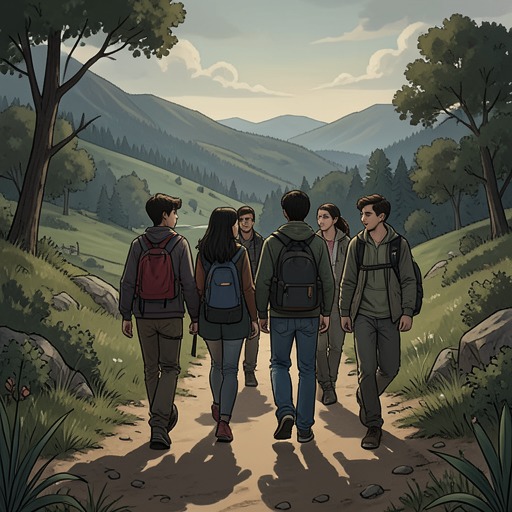
All the Bright PlacesWandering Around Indiana is both a school project and the framework for Theodore Finch and Violet Markey’s growing relationship. What begins with a lesson about Indiana’s highest point becomes a way to travel without reducing a place to a photograph or a checklist: they read maps, let the road redirect them, and leave traces of having been there. The project’s meaning changes with its participants. For Finch and Violet, it makes the familiar state newly visible; for Violet after Finch is gone, its places remain charged with his presence and with questions that cannot be answered by returning to them.
Origin and Purpose
The project enters the story through a new U.S. Geography unit called Wander Indiana, introduced by the school board to acquaint students with their home state. In class, Mr. Black explains that Hoosier Hill rises 1,257 feet above sea level and lies in the backyard of a family home. Finch is struck by the fact that he has lived in Indiana all his life without knowing the state’s highest point was nearby. The discovery prompts him to imagine standing there and to question what a view from that elevation might change.
Finch proposes a field trip with mock grandeur, comparing the need to visit Indiana’s sights in person to the need to experience the Grand Canyon or Yosemite. His sarcasm is real but incomplete: beneath it is a genuine wish to see the state before graduation. Mr. Black turns the proposal into a broader invitation, telling the class that some students will leave Indiana and should wander before they do. The lesson thus supplies the project’s official rationale, while Finch’s response supplies its personal one: places overlooked by other people may still matter, and visiting them together can make them matter to the visitors.
The project also creates a point of contact with Violet Markey. After seeing her humiliation in class, Finch asks her to be his partner, though he recognizes that he has effectively ambushed her into accepting. In a message, he explains that he has a map in his car and wants to visit places that deserve to be seen, even if no one else appreciates them. When Violet does not answer, he writes that he is there if she wants to talk. The invitation joins the practical plan to an offer of company, while leaving Violet room to respond in her own time.
Finch’s Guidelines and the Practice of Wandering
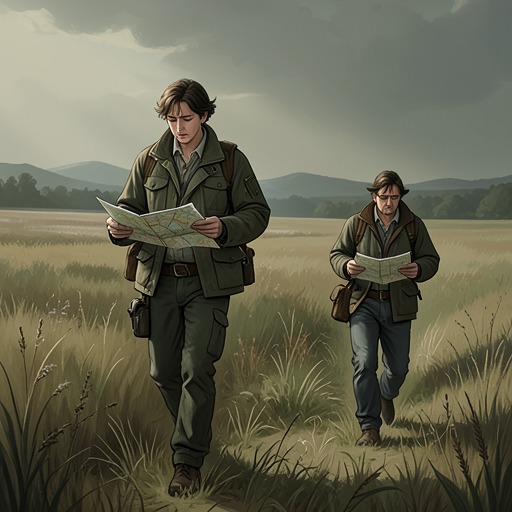
Finch calls his principles rules for wandering, then undercuts the formality by saying that life already has too many rules. He recasts the instructions as guidelines. The first forbids using phones to find the destinations: the pair must learn to read actual maps. The rule makes navigation part of the experience, requiring attention to the route rather than outsourcing it to a screen.
The second guideline has two parts. Finch and Violet are to alternate in choosing destinations, but they must also be willing to go where the road leads. Their itinerary can include the grand, small, bizarre, poetic, beautiful, ugly, or surprising; what it must exclude is the ordinary. The openness is not simply a promise to see many sights. It gives detours and unexpected places a legitimate place in the project, allowing the journey to alter its plans rather than treating every stop as a preselected achievement.
The third guideline asks them to leave something at each site, almost as an offering. Finch compares the practice to geocaching but changes its emphasis: instead of treating the visit as a game of finding an object, they give something back. Leaving a trace proves they were present and lets them leave a part of themselves behind. This gesture links the project’s outward movement through Indiana to its inward purpose of making shared experience tangible.
The guidelines also distinguish wandering from simply documenting a trip. When Violet wonders how they will collect material, Finch says they should be present rather than watching the experience through a lens. They do keep notes: at Hoosier Hill, Violet records the location, date, time, a description, and the children by a fence. But the notebook does not replace the encounter. The project asks them to notice first and turn the experience into a record second.
Places Made Significant by Visiting
Their first destination, Hoosier Hill, makes the project’s tension between expectation and experience concrete. The marker is a wooden stake among stones, beside a sign identifying the Indiana high point at 1,257 feet. A bench and picnic table sit under a tree, with a flat winter landscape beyond. Violet finds the site underwhelming, not a dramatic summit but a brown circle that hardly looks like a mountain. The discrepancy does not invalidate the visit. It gives Finch and Violet something real to see together, and Finch tells her that standing beside her makes the place feel as high as Everest.
At the picnic table, Finch spreads out a map and proposes that the pair visit every place of interest they can fit into the semester, not just the two wonders Mr. Black had mentioned. Violet points out that the agreement was for two. Finch nevertheless traces roads and circles destinations across the state, including Dune State Park, the World’s Largest Egg, the home of racehorse Dan Patch, the Market Street Catacombs, and the Seven Pillars overlooking the Mississinewa River. The marked map shows the project expanding in ambition even as the two continue to negotiate its limits.
At Bookmobile Park, outside Bartlett on a country road lined with cornfields, the landscape changes the scale of the visit. Seven bookmobiles stand in a line amid the fields; the first is a 1950s Airstream, and each trailer advertises a different category of books. Violet recognizes the excursion through an earlier family practice: in California, she, her parents, and Eleanor used to search bookstores for chosen titles, sometimes visiting eight or ten shops in one day. Bookmobile Park therefore connects the new wandering project with a form of exploration Violet already knows, while placing it in the open Indiana landscape Finch wants her to see.
A visit to Purina Tower gives the project a different kind of spectacle. The only way up is a steel ladder built into the side, with what feels to Violet like an enormous number of steps. At the top, beside a Christmas tree left there all year, they spread a blanket in the open space and look over lights scattered among dark patches of trees. Violet admits that the view is beautiful and calls it lovely. Finch treats the word, and the town below, as something they can share. The scene makes a place feel less like an item on a list than a temporary world that belongs to the two of them.
The project’s more hazardous destinations complicate that intimacy. On the first warm day, Finch leads Violet to the Blue Hole, a three-acre lake on private property in Prairieton. They bring offerings: the stubs of Violet’s SAT pencils and four broken guitar strings. The blue water, ring of trees, and privacy let Finch imagine that they are the only two people on earth. Yet the place is also surrounded by stories of danger: it is said to be bottomless, to conceal quicksand or an underground current, and to have nearly pulled two sheriff’s deputies into a whirlpool during an expedition in 1969. A destination can feel secluded and beautiful while carrying a threat that its visitors cannot dismiss.
Memory and the Project’s Afterlife
After Finch’s disappearance and death, the landscape does not return to neutrality for Violet. She goes back to the Blue Hole, passing no-trespassing signs and the house along the driveway before climbing the embankment and descending toward the water. The pool looks as blue as Finch’s eyes. Her return retraces a place they once shared, but the company that gave it its earlier meaning is absent. The visit turns the project’s practice of return into an encounter with loss rather than a continuation of their paired journey.
Violet also follows a road to Taylor Prayer Chapel, a tiny white chapel and steeple beside a lake, marked by a sign and a wooden cross. After taking the wrong fork and passing AIT Training and Technology, she doubles back and finds the chapel. She sits in the car after turning off the engine and wonders whether Finch came there on the day he died or the day before, and how he found the place. The project’s insistence on maps and attention to roads acquires a painful afterlife here: careful navigation can bring Violet to a place Finch may have visited, but it cannot supply the knowledge she seeks.
Wandering Around Indiana thus binds discovery to uncertainty. Its rules encourage Finch and Violet to resist ordinary routes, value small destinations, and make their presence matter through attention and offerings. The places themselves do not promise revelation: Hoosier Hill is modest, the tower’s beauty is momentary, and the Blue Hole’s beauty coexists with danger. What gives the sites significance is the act of reaching them and the relationship formed there. After Finch’s death, that same map becomes a structure for remembering him, carrying Violet back through shared places while making clear that a route can be retraced even when the person who first traveled it cannot return.